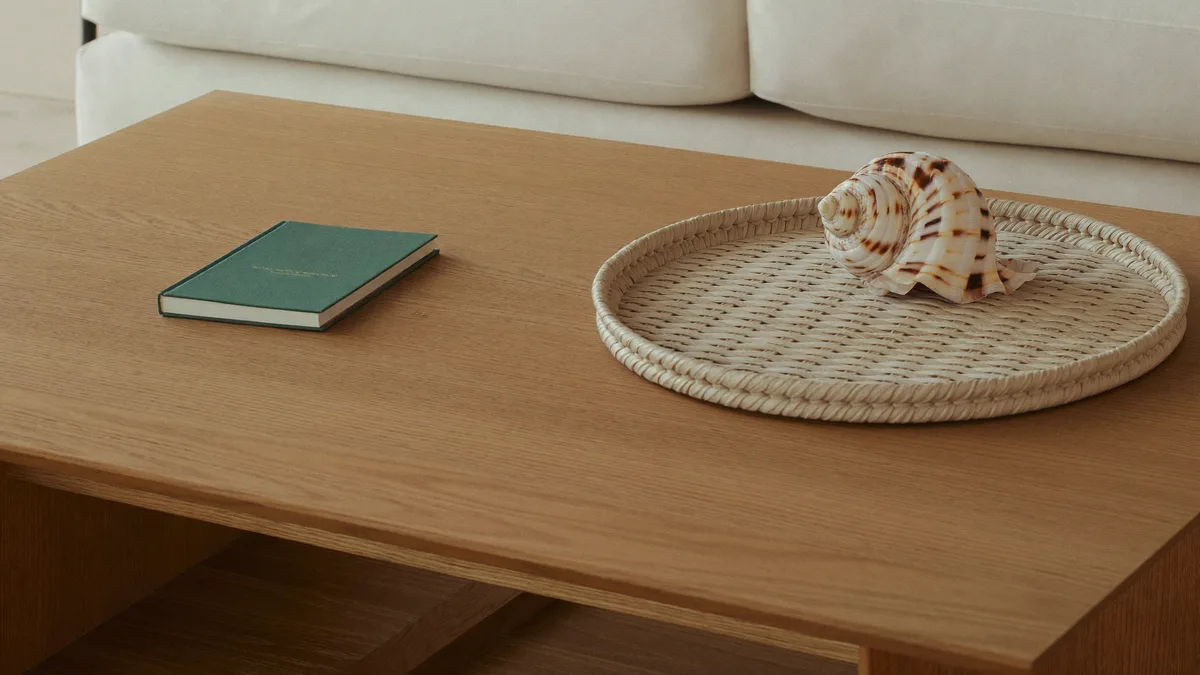
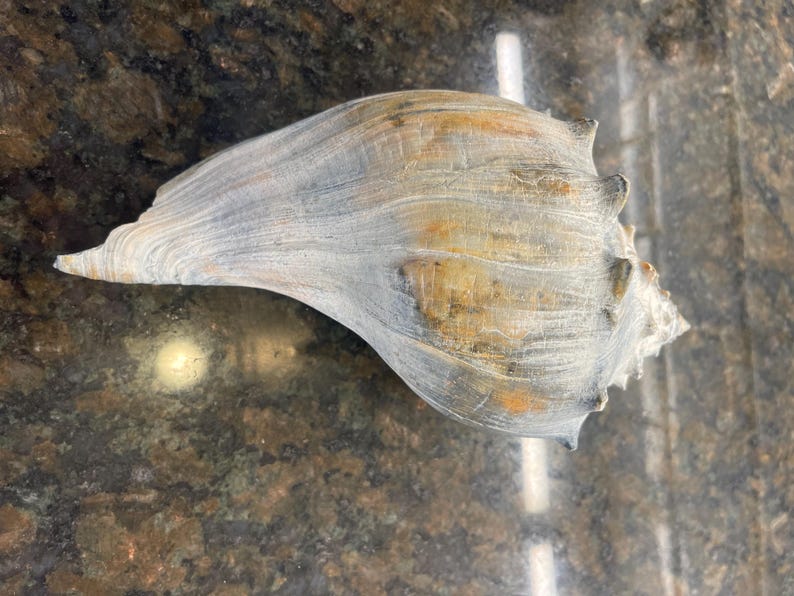
Whelks and true conchs are different groups of marine snails. The National Aquarium describes the familiar mid-Atlantic whelk shell as pear-shaped, with a long, tapering canal and a rounder opening. True conchs tend to have a shorter canal and a more elongated opening. See its whelk and conch comparison for photographed examples.
Use this guide for preliminary checks on an empty shell. It does not identify the species of any ShellHaul listing. A seller’s location also does not establish where a shell originated.
Start with a clear front view
Look for a photograph with the pointed spire at the top and the shell opening facing you. Include the entire shell in the frame. A close crop can hide the end of the canal; a side view can hide the opening’s edge.
Keep the listing open beside the worksheet below. For each row, write what you can see and mark anything obscured as “unknown.” Ask for another photograph before filling a gap from the title or a similar-looking product.
| Check | Look for | Photo to request |
|---|---|---|
| 1. Lower end | A long, narrow canal is a useful whelk clue. True conchs tend to have a shorter one. | A full-length view with both ends visible. |
| 2. Opening | Compare the rounder opening of a whelk with the more oblong opening of a conch. | A view straight into the opening. |
| 3. Lip detail | True conchs have a feature called a stromboid notch near the opening. Do not treat a hidden edge as proof that the notch is absent. | A close view of the intact outer lip. |
| 4. Coil and upper whorls | Record which side the opening faces, then look for raised knobs or a channel between the spiral turns. | A front view plus a view from above. |
The shape checks follow the National Aquarium comparison. North Carolina Sea Grant explains the notch and coiling clues. Treat the table as a way to gather evidence, rather than a complete species key.
Three whelk names you may encounter
Knobbed whelk: look for the raised peaks around the spiral top described in the National Aquarium’s knobbed whelk profile. Ask for a view that shows those projections clearly.
Channeled whelk: look for a deep groove between the whorls at the top. The National Aquarium’s channeled whelk profile shows and describes this feature. A photograph taken only from underneath may not answer that question.
Lightning whelk: North Carolina Sea Grant describes its opening on the left, while the channeled whelk coils to the right. Orient the shell before comparing it with a reference photograph. Do not rely on a mirrored image for this check.
Leave color and advertised length as separate observations. You can ask about them without treating either as a species confirmation. If the visible features conflict, send the seller the photographs you used and explain the mismatch.
A listing example, with one missing photograph
Fictional example: consider a listing titled “Atlantic conch shell.” Its photographs show a long lower canal and raised knobs around the top, but none shows the opening straight on.
Those visible features give you a reason to ask about a whelk. They do not settle the identification. Write “opening and lip unknown” in your notes, then ask: “Could you send a front view with the spire up? Do you know whether this is a knobbed whelk or another species?”
This example does not describe a ShellHaul item. Its purpose is to show how to turn an incomplete photograph into a specific request.
A message you can adapt for the seller
Hello, I’m interested in this shell. Do you know its species, and what information supports that identification? Could you share a photograph with the spire up and the opening facing the camera, plus a view of the upper whorls? Please confirm whether the photographs show the exact shell I would receive. Thank you.
Include the listing link with your message. If you need a named species for a collection or gift, say that before ordering. Save the seller’s answer alongside the listing details so you can refer to both when choosing.
Queen conch: check the official guidance
NOAA lists queen conch as threatened under the U.S. Endangered Species Act and in CITES Appendix II. Before arranging an international purchase of a shell sold as queen conch, consult NOAA’s queen conch conservation and management guidance and the relevant wildlife authority about the requirements for your route. A listing title or photograph does not establish permission to import it.
Choose the item after checking the name
Once you have the identification details you need, use our decorative shell buying guide to compare dimensions and condition. Our seashell display guide covers shelf and tabletop arrangements.
ShellHaul’s collection uses listing names including “Atlantic Conch Shell” and “Atlantic Whelk Shell.” Those names alone do not provide a confirmed species identification. Check ShellHaul on Etsy for current shop status and item details, or email ShellHaul with your question. The dated shop notice above records the planned return; check Etsy before planning an order.