By Sam
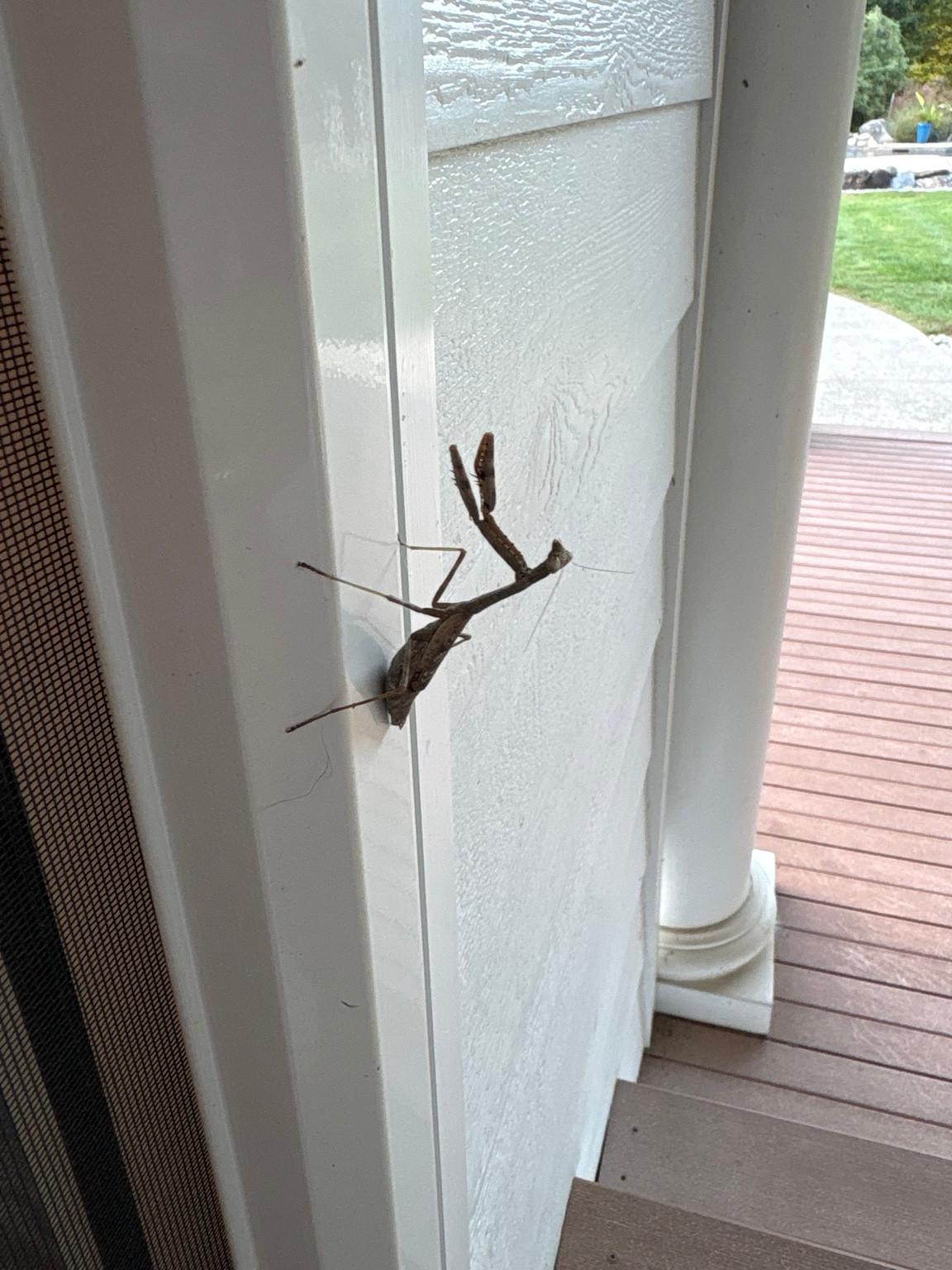
I saw four praying mantises near Phoenixville, Pennsylvania, without spending much time outside. They blend in so well that finding even one can take a second look. Seeing four raised a question: why are there so many around?
Fall makes them easier to notice
The season offers a good explanation. By late summer and fall, mantises that hatched earlier in the year have grown into adults. A tiny nymph tucked into a plant is easy to miss. A full-grown mantis moving across siding is a different story.
University of Maryland Extension describes this exact fall pattern: more reports can reflect larger, more visible adults, rather than more mantises than there were in spring. Adults also move around looking for food and mates, according to Penn State entomologist Joe Lelito’s eOrganic guide. [1, 2]
That makes October a reasonable time to notice them around southeastern Pennsylvania. Four sightings alone, though, cannot tell us whether the local population has increased. That would take repeated observations made in a comparable way, over time. For now, seasonal visibility is a plausible explanation for my sightings, not a measured Phoenixville population boom.
Built to disappear into the background
Look at the mantis in my photo. Its brown, mottled body stands out against the white siding. Put that same shape among dry stems and twigs, and it would be much harder to pick out.
Mantises often wait on flowers, shrubs, and other plants for prey. Their green or brown coloring and long, narrow bodies help them blend into that setting. The folded front legs are part of the hunting equipment: when an insect gets close enough, those grasping legs shoot out to catch it. [3]
Plant-filled edges and gardens offer places to wait and insects to eat. Crossing an open surface can make a normally hidden resident suddenly obvious. The photo shows that contrast especially well: the pale wall gives away an animal whose outline could disappear among plants.
Which mantis is it
There is more than one possibility in this region. The native Carolina mantis shares the eastern United States with introduced species, including Chinese and European mantises. They have different markings and body proportions, so a brown or green color alone is not enough for an identification. [1, 3]
The short-looking wings and mottled body in this photo suggest a female Carolina mantis, but I would keep that identification tentative. The angle leaves important details unclear, and there is no reliable size reference. For the photo caption, “praying mantis” is the most accurate label.
A predator with a broad menu
Mantises eat insects that gardeners may consider pests, but they also eat pollinators and other predators. NC State Extension specifically lists bees and butterflies among the Carolina mantid’s prey. They are fascinating animals to observe, with a much broader diet than a targeted garden pest treatment. [4]
Fall is also egg-laying season. Females produce a protective, foam-like egg case called an ootheca, which hardens around the eggs. The eggs overwinter, with young mantises emerging in spring. Leave found egg cases outdoors; indoor warmth can trigger hatching too early. [4]
For Creature Beach, this is a good reminder to look closely at the everyday places where wildlife turns up. A stem, a shrub, or a patch of siding can hold a surprising visitor. Sometimes the season simply makes a well-hidden neighbor easier to see.
Sources
1. University of Maryland Extension — October 21 2022 IPM Report, pages 5–6
2. Joe Lelito, Penn State University — Praying Mantids, eOrganic